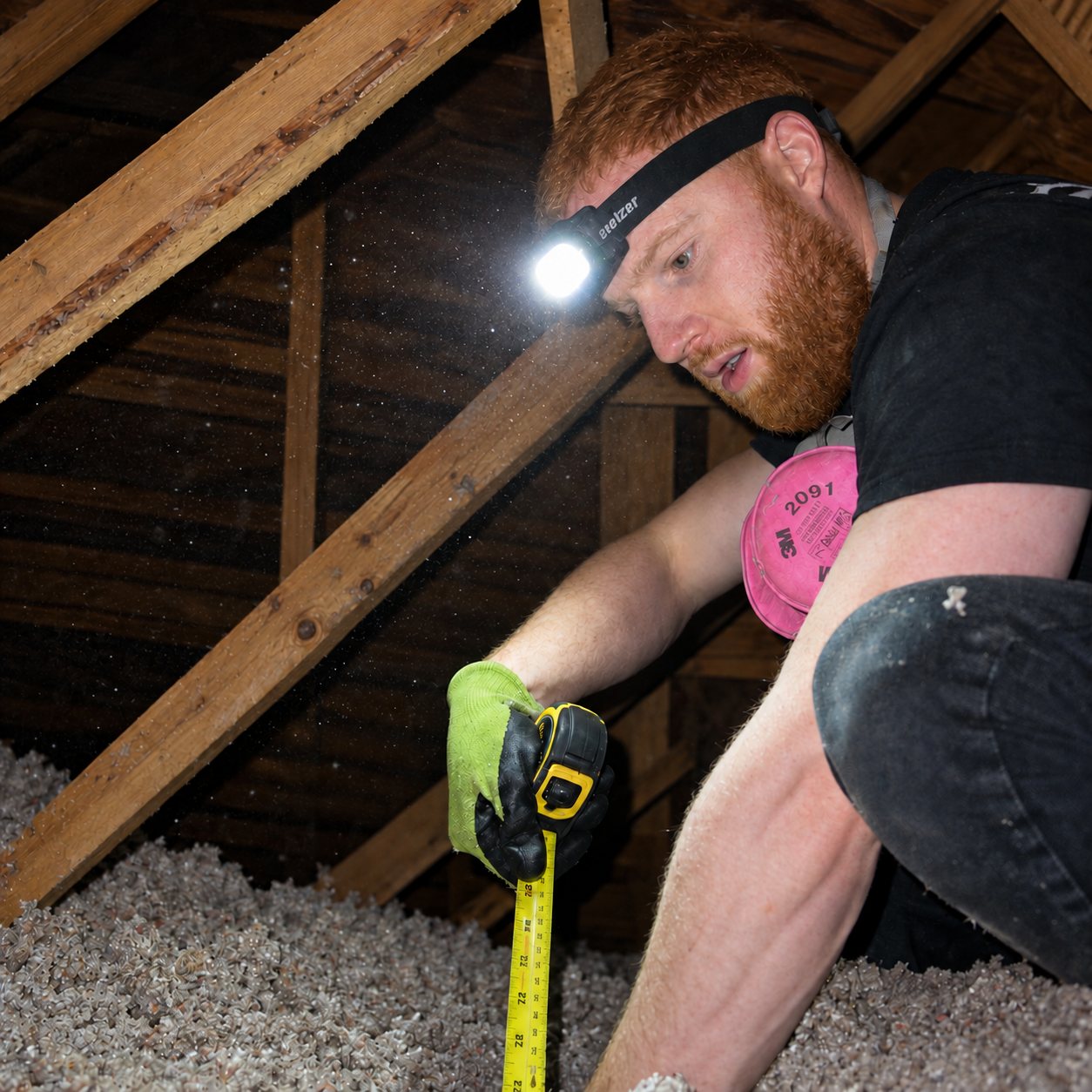
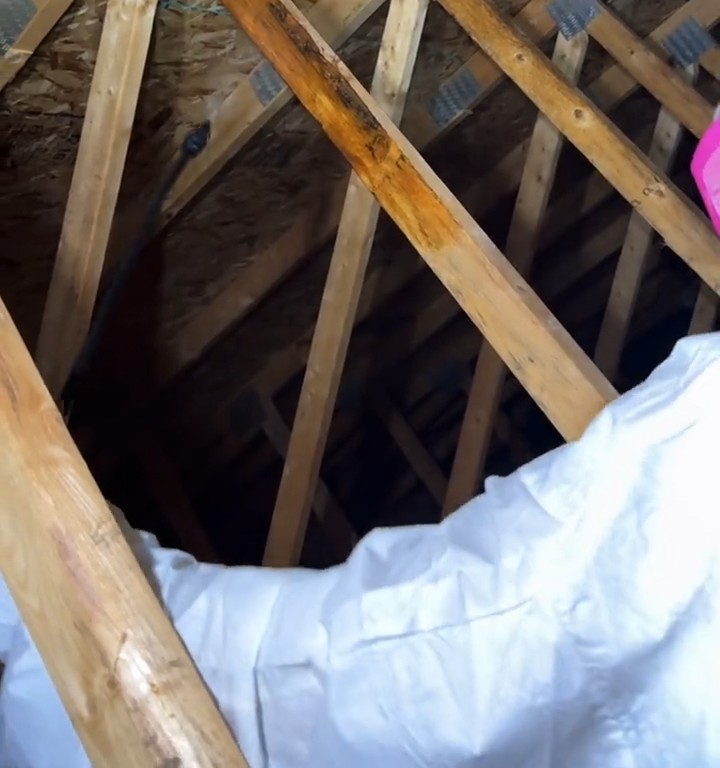
Signs of animals in the attic
- Scratching or running noises in the ceiling. Squirrels are mostly active during the day; mice and raccoons, mostly at night.
- Droppings, a smell of urine or nesting material in the attic.
- Insulation that is compressed, tunnelled or displaced, showing the tops of the joists.
- Openings gnawed or torn in the soffits, fascia, roof vents or where the roof meets the walls.
1. Identify the animal
How to get an animal out depends on the species: a mouse can get through a tiny opening, while a raccoon can tear off a soffit. In spring, there may also be young in the nest; ignoring them often leads to an animal trapped inside. A wildlife specialist or pest control company knows how to read the signs and choose the right approach.
2. Get the animals out before sealing the openings
Sealing an opening while an animal is still inside is a common mistake: the animal looks for another way out and causes more damage, or dies in the attic, which creates odours and more contamination. Specialists use methods that let the animal leave without being able to return, then close the access.
Raccoons: never trap or relocate a raccoon yourself. Raccoon rabies is present in Québec, and moving these animals is prohibited in some at-risk areas. Never touch a wild animal, alive or dead, with bare hands. Source (in French): Rage du raton laveur (Government of Québec).
3. Close the entry points
Once the animals are out, every opening must be closed with materials that resist gnawing: soffits, vents, fascia, and around chimneys and ducts. Without this step, other animals will come back, and the new insulation will be damaged in turn.
4. Assess the condition of the insulation
Once the animal problem is solved, an attic assessment shows what to do with the insulation:
- Can stay: insulation that is intact and clean. It can stay in place, and insulation is added to reach the target R-value.
- Needs correcting: insulation that is compressed or displaced. Its R-value is lower where it was packed down or tunnelled. It must be corrected and topped up.
- Must be removed: soiled insulation (urine, droppings, nests). It must be removed, partly or completely depending on the extent, before re-insulating. New insulation is never blown over contaminated insulation.
- Must be replaced: wet insulation. An opening made by an animal can also let water in. Wet insulation loses its performance and must be replaced.
Health risks from rodent droppings
Mice and other wild rodents can carry hantavirus. In Québec, infections are rare, but people can be exposed by breathing in particles of urine, droppings or saliva from infected rodents, especially when cleaning closed or poorly ventilated spaces such as an attic. Authorities recommend not sweeping or vacuuming droppings, and properly cleaning and disinfecting contaminated areas. Source (in French): Infection à hantavirus (Government of Québec).
That is why soiled insulation in an attic is removed with respiratory protection and disposable clothing, not by hand or with a household vacuum.
When does insulation need to be removed?
Removal is usually necessary when the insulation contains droppings, urine or nests, gives off a lingering odour, is wet, or when an animal has died in the attic. If the contamination is limited to one area, partial removal may be enough; the assessment is what determines this. If the original insulation is vermiculite, do not handle it without a lab test: it may contain asbestos.
Afterwards: re-insulating the attic
Once the contaminated insulation has been removed, it is the right time to fix the attic as a whole:
- reach at least R-50 (RSI 8.8);
- clear the soffits and install baffles to keep the ventilation working;
- seal air leaks, including the attic hatch.
If your house is heated mainly with electricity, this work may qualify for the $1,500 LogisVert assistance, provided all of its requirements are met, including both insulation and air sealing. See the LogisVert conditions.
Who does what?
Wildlife specialist or pest control company#
Identifies the animal, gets it out safely and lawfully, and closes the entry points.
Isolation Dumont#
Guides you once the animal problem is solved: attic assessment, explanations about the condition of the insulation and what can be corrected (removing soiled insulation, soffits, baffles, air sealing, re-insulation), and follow-up on your file. When work requiring a licence is recommended, the quote, contract and invoicing are handled by the licensed contractor responsible for the project, who also carries out the work.
Isolation Dumont does not offer pest control or animal removal services.
Frequently asked questions
Can new insulation be blown over soiled insulation?#
No. The contamination and odours stay trapped under the new layer. Soiled insulation must be removed first.
Does all the insulation in the attic have to be removed?#
Not always. If the contamination is limited to one area, partial removal may be enough. If droppings are spread over the whole surface, complete removal is usually better.
Can I clean the attic myself?#
For small traces in an accessible spot, follow public health guidance: no broom or vacuum, and proper disinfection. In an attic, the confined space, insulation dust and amount of material make the work much more exposing; it is better left to properly equipped professionals.
Does insulation attract animals?#
No, but no insulation keeps them out either. What matters are the openings in the building envelope. See: does blown insulation attract mice?
Sources
- Rage du raton laveur (Government of Québec, in French)
- Infection à hantavirus (Government of Québec, in French)
- LogisVert participation guide (Hydro-Québec, in French)
- Asbestos and your health (Health Canada)
← Back to the 100 questions about attic insulation in Québec